Custom Orthotics & Advanced Biomechanical Assessment
Don't Just Support Your Feet. Understand Them.
Foot pain isn't always caused by where it hurts.
The way your foot contacts the ground, how pressure moves beneath it, the mobility of individual joints, your walking pattern, footwear, previous injuries and the structure of your foot can all influence the forces travelling through your feet and lower limbs.
That's why at Podiatry Medic, we don't believe a custom orthotic should begin with simply taking a mould of your foot.
It begins with understanding why you are experiencing pain.
Our advanced biomechanical assessment brings together clinical podiatry, 3D foot scanning, plantar-pressure analysis, gait and walking video, hands-on biomechanical examination and diagnostic imaging where clinically indicated.
For patients requiring fully customised devices, these findings can then be incorporated into an advanced digital and AI-assisted design process alongside our biomechanical specialist team to create individually prescribed 3D-printed orthotics.
One Foot. Thousands of Data Points. One Individual Prescription.
Your feet are unique.
But more importantly, the way you use them is unique.
A static foot scan tells us what your foot looks like.
We want to understand what happens when you stand, walk, run, work or play sport.
That is the difference between simply fitting an insole and developing an individual biomechanical treatment plan.
The Podiatry Medic Biomechanical Assessment
Depending on your symptoms and clinical requirements, your assessment may incorporate:
1. Clinical Diagnosis
Before considering an orthotic, we first determine what we are treating.
Heel pain is not always plantar fasciitis.
Forefoot pain is not always a Morton’s neuroma.
And knee, ankle or arch pain cannot always be solved by changing foot posture.
Your consultation begins with a detailed history and clinical examination to identify the structures most likely responsible for your symptoms.
If we don't believe an orthotic is the appropriate treatment, we will tell you.
2. 3D Digital Foot Scan
Our digital 3D scanning system captures the individual contours and architecture of your feet.
This provides a highly detailed digital representation of your foot from which a fully customised orthotic can be designed.
There are no generic arch shapes and no assumption that two people with the same shoe size require the same support.
Your feet become the starting point of your prescription.
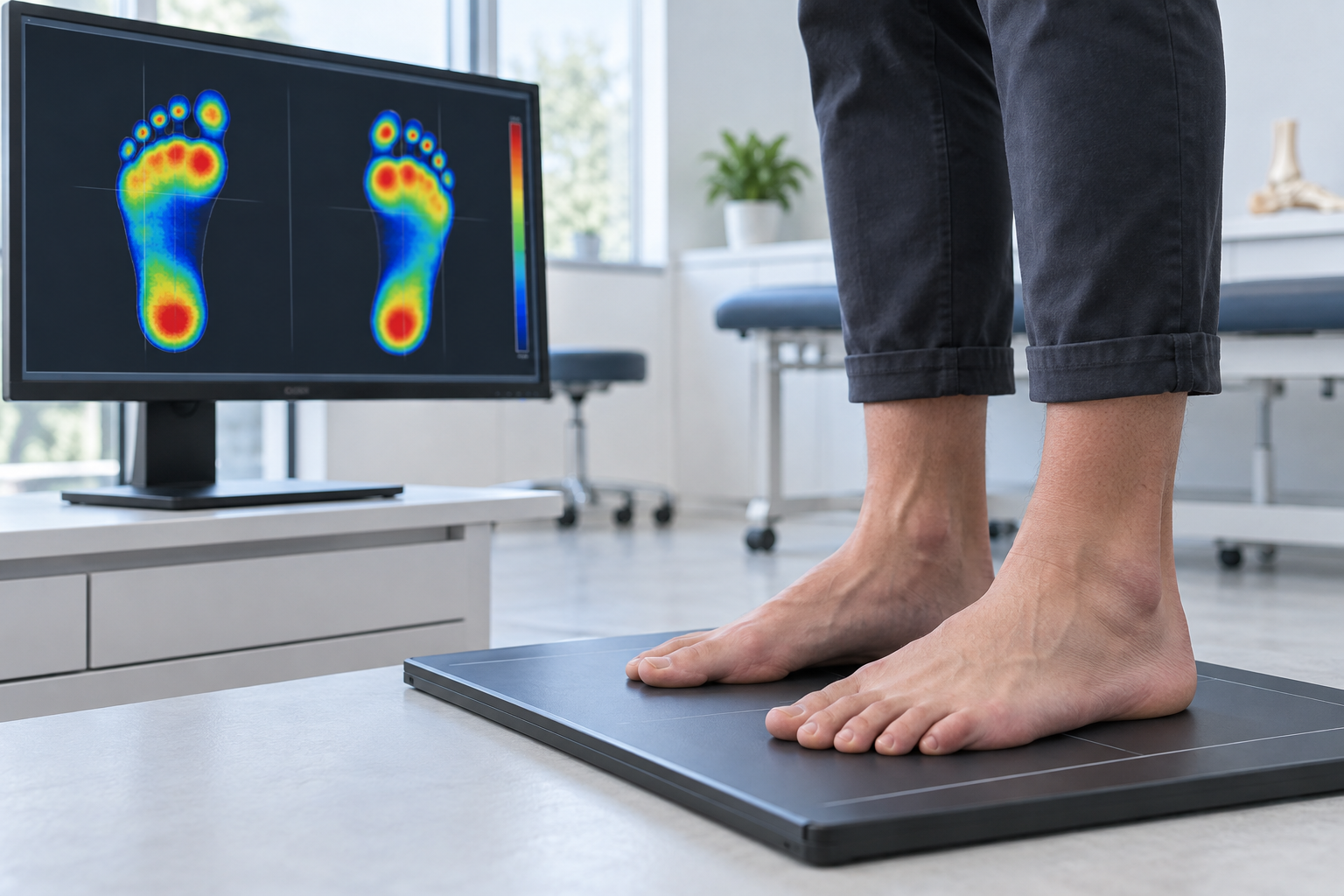
3. Plantar Pressure Mapping
Where you feel pain and where your foot generates excessive pressure are not always the same place.
Our pressure platform allows us to visualise how pressure is distributed beneath your feet during standing and movement.
It can help identify:
• excessive heel loading
• forefoot overload
• pressure beneath individual metatarsal heads
• asymmetry between your feet
• areas associated with recurrent callus and corns
• altered loading around painful joints or structures
This information allows us to consider not only the shape of an orthotic, but where forces may need to be redistributed.
4. Video Gait & Movement Analysis
Your feet were designed to move.
So we assess them moving.
Walking video provides another layer of information about how your foot and lower limb behave dynamically.
We may assess:
• foot progression
• pronation and supination patterns
• heel position
• propulsion
• timing of movement
• left-to-right asymmetry
• ankle and lower-limb movement
• sport or activity-related mechanics where relevant
The objective isn't to make everybody walk identically.
It is to identify movement or loading characteristics that may be relevant to your individual symptoms.
5. Hands-On Biomechanical Examination
Technology is powerful, but it does not replace clinical examination.
Your podiatrist manually assesses the structures relevant to your problem.
This may include:
• ankle range of motion
• first-ray function
• big-toe joint mobility
• subtalar and midfoot function
• foot posture
• muscle and tendon function
• joint restriction
• areas of tenderness
• lower-limb alignment
• previous injury
This allows the digital information to be interpreted within the context of your actual clinical presentation.
When We Need to Look Deeper
Diagnostic Imaging
Sometimes biomechanics isn't the whole answer.
If your examination suggests an underlying structural injury or pathology, we can refer for diagnostic imaging before committing you to an orthotic.
Depending on the clinical presentation, this may include:
• weight-bearing X-rays
• diagnostic ultrasound
• MRI where indicated
• specialist orthopaedic assessment
Imaging can be particularly important when investigating conditions such as plantar-plate tears, Morton’s neuroma, intermetatarsal bursitis, arthritis, stress injury, tendon pathology and progressive structural deformity.
We believe this is an important distinction.
An orthotic can help redistribute forces around many painful structures, but it cannot repair every structural injury.
We want to know what we are treating first.
From Clinical Assessment to Digital Prescription
Advanced AI-Assisted & Specialist Orthotic Design
For our fully custom devices, the information gathered during your assessment can be incorporated into an advanced digital design workflow.
Depending on your presentation, your prescription may incorporate:
• your 3D foot scan
• plantar-pressure findings
• walking/gait video
• manual biomechanical measurements
• diagnosis
• imaging findings
• previous injuries
• footwear
• occupation
• sporting requirements
• painful or vulnerable structures
• areas requiring additional accommodation or offloading
This information can then be used within an AI-assisted digital workflow together with clinical oversight and input from our biomechanical specialist team.
The objective is not to allow software to replace your podiatrist.
It is to give your podiatrist and design team more information with which to create an individual prescription.
Your final custom orthotics are then manufactured using advanced 3D-printing technology.
What Can Orthotics Actually Do?
An orthotic isn't simply an “arch support.”
Depending on the prescription, an orthotic may help:
• redistribute pressure beneath the foot
• unload painful or injured structures
• improve comfort during walking and standing
• alter forces passing through specific areas of the foot
• accommodate prominent or sensitive structures
• support particular areas of the foot
• improve footwear interaction
• manage forefoot overload
• reduce repetitive stress on selected tissues
• improve comfort during sport and exercise
Importantly, we don't try to force every foot into a theoretical “perfect” position.
Our goal is to identify the mechanical factors relevant to your symptoms and determine whether changing those forces may help you.
Conditions We Commonly Treat
Orthotic therapy may form part of the treatment plan for:
Heel & Arch Pain
Plantar fasciitis
Plantar heel pain
Arch fatigue
Selected flat-foot conditions
Forefoot Pain
Metatarsalgia
Morton’s neuroma
Intermetatarsal bursitis
Plantar-plate injuries
Sesamoid pain
Recurrent plantar callus and pressure lesions
Big-Toe & Joint Problems
Hallux valgus / bunions
Functional hallux limitus
Arthritis of the foot
Painful or restricted joints
Tendon & Lower-Limb Problems
Achilles tendon problems
Posterior tibial tendon dysfunction
Peroneal tendon overload
Selected shin, ankle and knee presentations
Foot Types
Flat feet / pes planus
High arches / pes cavus
Pronated foot types
Asymmetrical loading patterns
Orthotics are prescribed according to your diagnosis. They are not appropriate or necessary for every patient.
Built for Queenstown
Orthotics for the Way You Actually Live
Queenstown places unusual demands on feet.
Our patients don't simply walk across flat floors.
They run trails, ski, snowboard, hike, tramp, cycle, play golf, work long hours on their feet and train in the gym.
Your orthotic needs to work in your world.
Running & Trail Running
Long-distance repetitive loading can amplify relatively small pressure or biomechanical problems.
Your assessment considers both your foot mechanics and the demands of your running footwear and terrain.
Skiing & Snowboarding
Ski boots create an entirely different biomechanical environment from ordinary footwear.
Space is limited and small changes beneath the foot can significantly affect comfort.
Low-volume orthotic designs can be considered specifically for ski and snowboard boots.
Hiking & Tramping
Long periods of weight-bearing, uneven terrain, elevation and heavy packs place considerable demands on the feet.
Orthotic therapy may help redistribute pressure and improve comfort over longer distances.
Cycling
Cycling footwear is rigid and highly constrained.
Orthotic prescription can take shoe volume, forefoot pressure and the requirements of cycling footwear into consideration.
Golf
Walking significant distances combined with rotational forces through the feet makes comfort and stability important throughout a round.
Tennis, Pickleball & Court Sports
Acceleration, braking and repeated directional changes require a device that considers dynamic movement rather than simply static arch support.
Gym & Strength Training
Squatting, lunging, lifting and repetitive training all create different loading patterns through the foot.
Everyday Life
You don't need to be an athlete.
If your goal is simply to walk the dog, work without pain, travel comfortably or get through the day without thinking about your feet, that matters just as much.
Not Everyone Needs Custom Orthotics
And we think that's important.
Podiatry Medic offers three levels of orthotic therapy so that your treatment can match your actual clinical requirements.
Fully Custom 3D-Printed Orthotics
Our most individualised option.
Designed from your clinical and biomechanical assessment and manufactured specifically for your feet using advanced digital design and 3D printing.
These may be appropriate where there is:
• complex biomechanical dysfunction
• significant asymmetry
• unusual foot architecture
• specific pressure redistribution requirements
• recurrent or persistent symptoms
• structural pathology requiring targeted accommodation
• sport-specific requirements
• failure of simpler orthotic options
Semi-Custom Formthotics™
For many patients, this is all the customisation they need.
Formthotics™ originated here in New Zealand and have developed into an internationally used medical orthotic system.
They are manufactured from specialised closed-cell Formax™ foam rather than ordinary cushioning or memory foam.
The material can be heat moulded to the individual foot and shoe, allowing the device to conform more closely to the patient's foot.
We can then clinically modify the device according to your individual needs.
Depending on your presentation, modifications may include:
• metatarsal domes
• pressure offloading
• heel modifications
• posting
• padding
• local accommodation
The result sits between a generic shop-bought insole and a fully digitally prescribed custom device.
For the right patient, it provides an excellent combination of support, comfort, personalisation and value.
Prefabricated / Off-the-Shelf Orthotics
Sometimes you don't need anything more complicated.
A carefully selected prefabricated orthotic can provide effective support and cushioning for many mild or straightforward presentations.
They are also useful:
• as an initial treatment trial
• while recovering from an injury
• for secondary footwear
• where symptoms are mild
• when additional cushioning or support is the primary requirement
We don't simply choose an insole according to your shoe size.
We select it according to your foot, footwear, symptoms and clinical requirements.
Why Podiatry Medic?
Because We Don't Start With the Orthotic.
We start with you.
Your symptoms.
Your diagnosis.
Your feet.
Your movement.
Your pressure patterns.
Your footwear.
Your sport.
And what you actually want to get back to doing.
Then we decide whether an orthotic belongs in your treatment plan at all.
When appropriate, we can combine:
✓ Clinical podiatric diagnosis
✓ Hands-on biomechanical assessment
✓ 3D digital foot scanning
✓ Plantar-pressure mapping
✓ Walking and gait video analysis
✓ Advanced digital and AI-assisted orthotic design
✓ Biomechanical specialist input
✓ 3D-printed manufacturing
✓ Diagnostic X-ray, ultrasound and MRI referral where indicated
✓ Orthopaedic referral when the problem requires more than an orthotic
✓ Custom, semi-custom and prefabricated treatment options
One Assessment. A Much Bigger Picture.
The best orthotic isn't necessarily the most expensive one.
It's the one prescribed for the right patient, for the right reason.
If foot or lower-limb pain is stopping you from running, skiing, hiking, working or simply walking comfortably, book an assessment with Podiatry Medic.
Let's find out what is actually causing it.
BOOK A BIOMECHANICAL & ORTHOTIC ASSESSMENT